

We are Carme and Mila, both software engineers at FreeAgent, where we collaborate as mentee and mentor.
In this blog we interview each other about our mentoring relationship. We’re hoping that our experience is universal and sharing our insights will be useful to anyone who is interested in mentoring.
If you like what you read, why not give it a try!
The mentee’s perspective – Carme
When did you reach out for a mentor and what made you do it?
I wanted to move to a team within FreeAgent that worked on the main product but I needed to level up my Ruby and Rails knowledge. I had worked with both in the past but not for long enough to feel confident in either.
FreeAgent has a voluntary mentoring program, complete with guidelines for both prospective mentors and mentees which include a list of colleagues who are happy to mentor. But I wasn’t sure how to find the right one…
In the end, the connection happened out of the blue while chatting at the Christmas party ☺️. Mila had mentioned she was mentoring a couple of people, I said I was looking for a mentor, and we agreed to talk more in January.
That was three years ago and we’re still going!
What qualities in a mentor help your learning?
First of all, the way Mila organises the mentoring sessions really fits my learning style. I learn best when using a variety of media, mixed in with time for hands-on building as well as enough quiet time to mull over new concepts.
At the beginning, Mila recommended a couple of sites and books to help cement the fundamentals. I’d go away, read a chapter, do some exercises, build some stuff, and then, at the next session, explain the new concepts to Mila and bring any questions I may have. But she wouldn’t necessarily give me the answers straight away, instead guide me towards them. This still is super helpful as, in my experience, it is easier to understand and assimilate a new concept if you have had to work it out.
With time the mentorship sessions have become less structured, focusing on a list I keep of concepts I want to learn more about. I bring some of the more gnarly ones to Mila who will help me clarify, correct, or point me towards useful resources for further digging.
Being mentored by Mila is like learning to ride a bicycle with an encouraging big sister. She keeps in mind the destination and a map of the route, and provides the right proportion of guidance and freedom to allow me to learn from exploring and falling over a few times, while still gaining confidence and learning to stay safe.
In my experience, it is easier to understand and assimilate a new concept if you have had to work it out.
What is mentorship providing that you wouldn’t get otherwise?
Constant learning is a must in the tech industry.
Over the years, I have done a lot of it by myself and it works perfectly well with a clear path of where to get to. But learning by yourself without guidance can be both very ineffective and inefficient.
For a start, how do you decide what is worth learning? There is always a lot of hype around new tools, technologies, and languages. Some will change the industry forever, and others will fade away just as quickly as they’ve appeared.
Also, how do you shed light on your blind spots? It’s much easier if you have the input from someone objective and experienced who is also willing to help you find, and fill, the gaps in your knowledge.
The human connection is another aspect that you won’t get from a pre-recorded online course. During a mentorship, you are working with – and getting to know – someone from the same industry who is further ahead in their career. They may or may not have taken a similar path, but their experience and insight can be very valuable and a source of inspiration.
The mentor’s perspective – Mila
What are the benefits of being a mentor?
In short: learning together! It may seem like the mentoring process is something the mentee benefits from the most, but in fact you benefit just as much. You cannot explain concepts without understanding them fully. Allowing yourself the vulnerability to be asked a question – any question – will really challenge you and make you consider problems from angles you hadn’t thought about before. As an added bonus, you get better at translating your thoughts into words – after all your mentee should understand what you are talking about as well!
Another plus is that you learn patience and improve your listening skills. You need to be able to slow down and adjust your speed to give the people around you space to process information. You may have enthusiasm to share your knowledge, which is great but it’s also crucial to have empathy and realise that going too quickly can be exhausting for mentees. The process of allowing others this space makes you more aware of their needs.
When did you start being a mentor and why?
Starting out as a junior engineer in jobs prior to FreeAgent, I didn’t have the support and safety to grow. It was difficult to navigate an unfamiliar environment. Having overcome the challenge of adapting, I was determined to do my best for people at the beginning of their career and offer the support that was lacking in my opinion.
FreeAgent has a really good culture around mentoring, investing in people and psychological safety, providing me with the opportunity to give others what I didn’t have.
What do you wish you knew before starting to mentor?
I wish I’d known that you don’t have to know everything to be a mentor and you know more than you realise. A lot of times it’s not about knowing all the answers but more about externalising your way of thinking and the process of getting to an answer.
In fact it is really healthy to say “I don’t know” as a mentor as it portrays a more real and achievable version of seniority and helps us let go of perfectionism.
How do you adapt to the person you are mentoring?
You need to be prepared to stop explaining and start enabling.
Listen first. Allow your mentee to speak. Mentorship meetings are their meetings and allowing them to take charge will naturally lead to them sharing what they need, what they value and find important. Then it’s easy to set the priorities of your mentoring sessions.
It’s also important to note that mentorship relationships evolve all the time. At the start people benefit more from instructions about what to do and want answers. As time goes on they benefit more from opportunities and taking initiative, which sadly (for your ego) means that they will need less of your help. You need to be prepared to stop explaining and start enabling.
About us
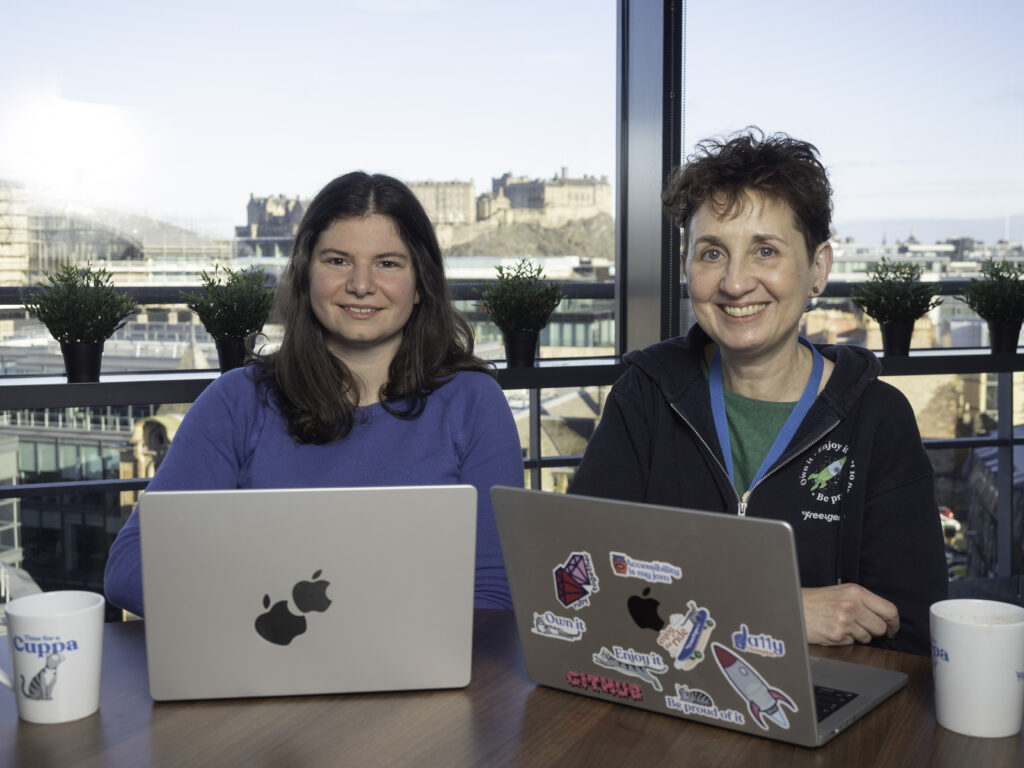
Carme Mias
I have been working in a wide variety of tech industry roles, since the mid nineties. The first part of my career spans jobs in hardware, support, and on-premise networks. After a break to look after family in the early 2000s, I taught myself web development and freelanced for a number of years. Then, in 2019, I completed the CodeClan software development course and have since been working as a full stack software engineer.
I consider myself a returner to tech and have been loving the ride so far!
Mila Kirova
I am originally from Sofia, Bulgaria – after my secondary education at the Sofia High School of Mathematics I moved to lovely Scotland where I completed a Computer Science degree at the University of Edinburgh. I worked with various companies in the financial sector before deciding to focus all my attention on Ruby on Rails and the accounting world by joining FreeAgent. I am passionate about my personal learning and supporting others in their growth and empowerment.